Contents show
The four pricing models
Anyone comparing rates usually ends up comparing apples with oranges. There are four ways to bill for customer support, and each one shifts the risk to a different side.
| Model | How it works | Suits |
|---|---|---|
| Per ticket | You pay a fixed amount per customer contact handled | Stores with variable volume; you never pay for idle time |
| Per hour | You buy hours, regardless of how many questions fit into them | Complex questions that take a long time, or phone support |
| Fixed monthly | A subscription with an agreed capacity | Predictable volume that barely fluctuates |
| Dedicated agent | Someone works for you alone, often booked in half-days | Larger brands with their own systems and deep in-house knowledge |
For most online stores this is per ticket the fairest model: you pay exactly for the work that was done. Drop from 500 to 200 questions in a quiet month and your bill drops with it. On an hourly model or a subscription you keep paying for that capacity regardless.
What the rates actually are
The ranges below are what you come across for email and message handling. They vary widely, mainly because some providers work offshore and others with a local team.
| Model | Range | At 500 tickets per month |
|---|---|---|
| Per ticket | EUR 0.50 to 2.50 per ticket | EUR 250 to 1,250 |
| Per hour | EUR 22 to 45 per hour | EUR 1.100 to 2,250 (at roughly 50 hours) |
| Fixed monthly | EUR 250 to 1,500 | Depends on the agreed bundle |
| Dedicated | EUR 1.800 to 3,500 per month | Fixed cost, regardless of volume |
For reference, Flowdesk charges EUR 0.70 per ticket on the Basic rate, which means you start at around EUR 200 per month. Dispute management and the dashboard are included, and there are no setup fees.
Outsourcing versus hiring in-house
The real comparison is not rate against rate, but rate against payroll. A customer support employee working 32 hours a week costs roughly EUR 2.800 to 3,600 per month in the Netherlands once you add gross salary, employer contributions, holiday pay, pension, training and tooling.
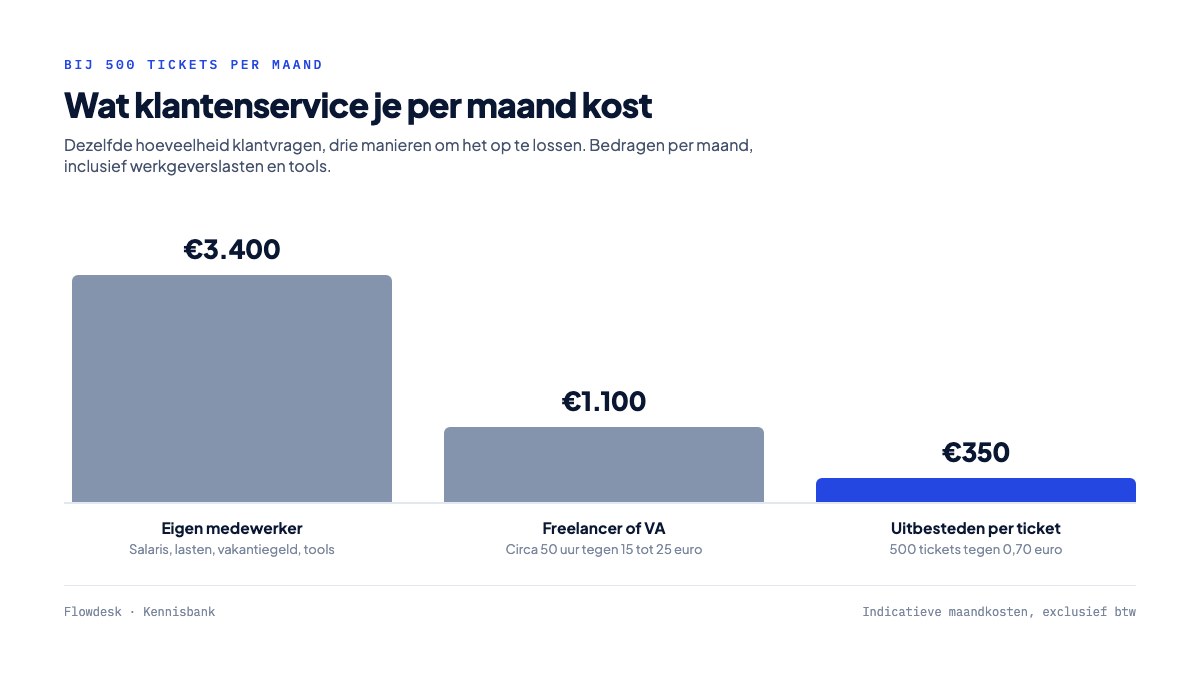
More important than the difference in amount is the difference in what you are buying. With an employee you buy capacity: it costs the same in a quiet month, it is absent when they are ill or on holiday, and it cannot absorb a weekend peak. Outsourcing per ticket you buy work: if your volume moves, your bill moves with it, and staffing is not your problem.
Hiring in-house wins as soon as your volume is high and stable, your questions are highly specialist, or you want someone physically in the office. Below a thousand tickets a month, outsourcing is almost always cheaper and more flexible.
The hidden costs to watch for
- Setup or onboarding fees. Ask whether configuration, integrations and training are billed separately.
- Minimum commitment. A rate of EUR 0.50 sounds great, but not with a floor of a thousand tickets a month underneath it.
- Cost per channel. Do they charge extra for social or WhatsApp alongside email?
- Dispute management. Often a separate line item, even though that is exactly where the money is. One won dispute of EUR 80 pays for a hundred tickets.
- Reporting and dashboard. Sometimes a paid add-on rather than a standard part of the service.
- Contract term. An annual contract with a notice period makes a cheap rate expensive if it turns out not to work.
Work it out yourself in three steps
- Count your tickets. Look in your mailbox and count the new customer questions from last month. As a rule of thumb assume 2 to 5 percent of your orders if you do not know exactly, and more with long delivery times.
- Set them against the rate. Multiply by the per-ticket rate and compare with the payroll cost you have now or would have.
- Count the disputes too. Work out what lost disputes and chargebacks cost you last quarter. Save half of that and the sum usually changes completely.
Against roughly EUR 3.400 for an employee doing the same amount of work. Win four disputes averaging EUR 80 on top of that and outsourcing makes you money each month rather than costing you any.
What to watch for when choosing
Price is rarely the problem; expectations are. So ask about these six things up front:
- What is the average response time, and is that a commitment or an ambition?
- Do they write under your brand name, in your tone of voice?
- Is dispute management part of the service or a separate line item?
- Do you see what is happening live, or only get a monthly report?
- Who is your point of contact and how do you reach them?
- Can you cancel monthly?
If you want to know when outsourcing makes sense for your situation and where ecommerce trips up, read on about dropshipping customer service.
Frequently asked questions
How much does outsourcing customer service cost per month?
What is the cost per ticket for outsourced customer service?
Is outsourcing cheaper than hiring someone?
What exactly counts as a ticket?
Which pricing model is best for an online store?
Why is per ticket cheaper than per hour?
Are there setup fees when outsourcing customer service?
How many tickets does an online store get on average?
What does outsourcing dispute management cost?
How much do I save by outsourcing customer service?
Can I cancel monthly with a customer service partner?
Is outsourced customer service a deductible business expense?
Wessel builds the systems, automations and processes behind Flowdesk and writes in the knowledge base about disputes, chargebacks and customer service for online stores. His articles are based on the hundreds of disputes the Flowdesk team handles every month for online stores and dropshippers. Questions about this article: info@flowdeskagency.com.
Want to know what it would cost for your store?
Tell us your ticket volume and we will work it out with you in fifteen minutes, no strings attached. Basic starts at EUR 0.70 per ticket.