Contents show
Why dropshipping customer service works differently
In a regular store the stock sits in a warehouse you can call. In dropshipping there is a supplier in between whom you never see, often in another time zone, and they decide whether your customer is happy. That difference makes three things structurally harder: the delivery time is longer and less certain, you have no direct control over packaging and quality, and you only find out about problems when a customer complains.
The effect is measurable. Where a regular store gets a customer question on 2 to 5 percent of orders, in dropshipping that is often 8 to 10 percent. And because most of those questions are about delivery, they sit closer to a dispute than to an ordinary question.
Pitfall 1: not actively managing delivery time
The biggest source of tickets, and the easiest one to shrink. Customers do not get impatient because of a long delivery time, they get impatient because of silence. Waiting two weeks is fine when you know it takes two weeks.
What works: put the realistic delivery time on the product page and repeat it in the confirmation email. Send a message on dispatch, on arrival in the destination country and on delivery. If it runs late, email before the customer emails you. Every proactive message prevents several questions on average and keeps the customer away from their payment provider.
Pitfall 2: no grip on your sourcing agent
Complaints land in your mailbox, but the cause sits with the supplier. If that information never flows back, the same problem repeats every week and you spend your time treating symptoms.
What works: log the reason for every complaint in categories, not in free text. Send your sourcing agent a weekly summary: this product arrived damaged five times, this size consistently runs small. Concrete numbers change behaviour, individual complaints do not. Also agree who bears the cost when the fault is on their side.
Pitfall 3: returns without a clear policy
Returning goods to China often costs the customer more than the product is worth, and rarely pays off for you either. Without a policy everyone improvises something different, and that costs money and goodwill.
What works: set a decision rule by order value in advance. For example: under EUR 25 no return, just refund or reship, because the shipping cost exceeds the value. Above that, return to a local address or to the supplier. Put it in your terms and on your returns page so the customer knows before buying. And remember: if you sell to consumers in the EU, the statutory fourteen-day right of withdrawal applies to you as a dropshipper too.
Pitfall 4: spotting disputes too late
A dispute at PayPal or Klarna often carries a ten-day deadline. If your sales run through four payment methods, those notifications live in four different dashboards and get lost among your normal email. A missed deadline is an automatically lost case.
What works: turn every dispute into a task with a deadline in one place, and check your providers' dashboards at least twice a week. Read what each payment method requires; the PayPal dispute playbook shows what that file should look like. Also look at what a chargeback really costs you, because that makes clear how much a won case is actually worth.
Pitfall 5: doing everything yourself until it breaks
In the beginning you handle customer service on the side. That works, until your marketing lands. Then your order volume doubles and your mailbox triples, exactly in the period when you should be working on growth. The familiar pattern: your ads are performing, but you never get round to scaling because you spend your evenings clearing tickets.
What works: decide your tipping point in numbers up front, not on feel. For example: above 150 tickets a month I outsource. Work out what an hour of your time is worth compared to a per-ticket rate; in what customer service outsourcing costs the amounts sit side by side. One thing matters: pick a partner who speaks the language of dropshipping and knows how a delivery-time dispute at PayPal works.
Pitfall 6: not measuring where your tickets come from
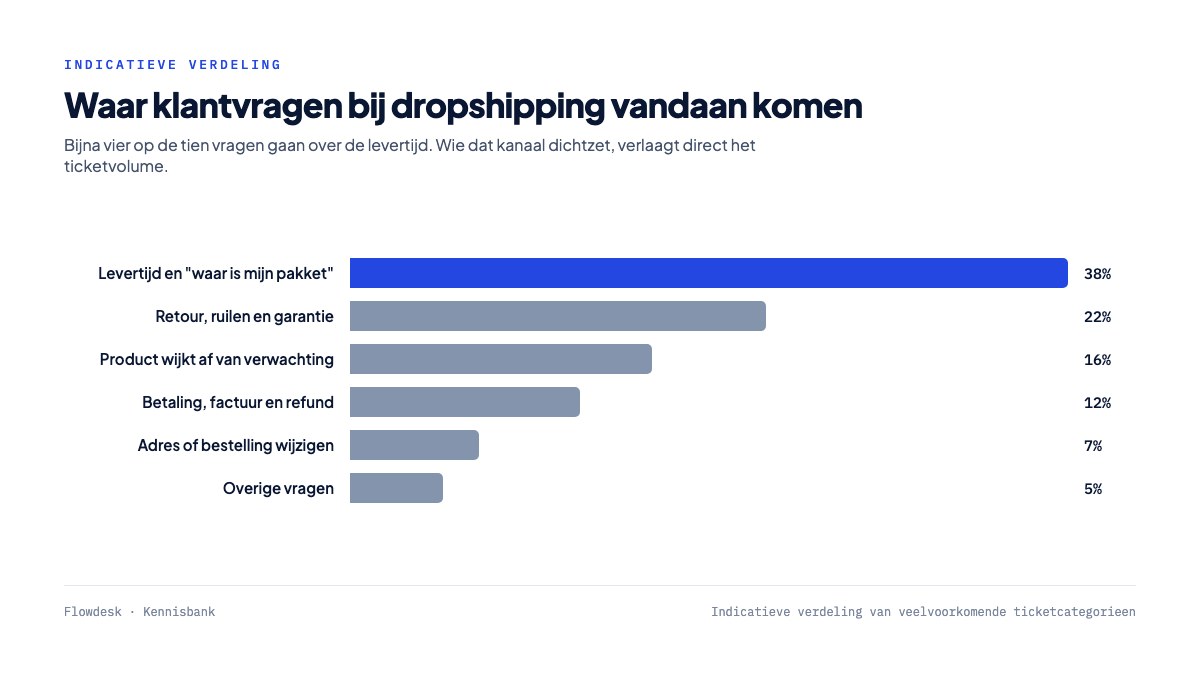
Without categories, customer service stays a cost you can only work through. With categories it becomes an improvement list: if 38 percent of your questions are about delivery time and half of those concern the same product, you know exactly which product page or supplier to tackle.
What works: label every ticket with a fixed reason (delivery time, return, product not as described, payment, address change, other) and look at the top three each month. Every category you solve at the root disappears from your mailbox permanently. That is the difference between handling tickets and reducing ticket volume.
Frequently asked questions
How many customer questions does a dropshipping store get?
Is dropshipping legal?
Who is liable for a faulty product in dropshipping?
Do I have to accept returns as a dropshipper?
Do I have to pay return shipping as a dropshipper?
What is a reasonable delivery time in dropshipping?
How do I prevent disputes about long delivery times?
How do I deal with a customer whose parcel never arrives?
Can I outsource customer service for my dropshipping store?
How much time does dropshipping customer service take per week?
Which language should I offer customer service in?
What should I agree with my sourcing agent about complaints?
Wessel builds the systems, automations and processes behind Flowdesk and writes in the knowledge base about disputes, chargebacks and customer service for online stores. His articles are based on the hundreds of disputes the Flowdesk team handles every month for online stores and dropshippers. Questions about this article: info@flowdeskagency.com.
Grow without your mailbox filling up
Flowdesk takes over the tickets, returns and disputes of dropshippers, talks to your sourcing agent and reports every month on where your ticket volume comes from.