Contents show
Dispute, claim or chargeback?
At PayPal these are three different things, and the difference decides who rules on it and how much room you have.
| Type | Who decides | Your room to act |
|---|---|---|
| Dispute | You and the customer together, in the Resolution Center | Wide: you can still talk it through and resolve it |
| Claim | PayPal, after the dispute is escalated | Limited: you submit evidence and PayPal decides |
| Chargeback | The customer's bank or card issuer | Narrow: the card issuer decides and PayPal passes your evidence on |
The lesson is simple: resolve it while it is still a dispute. Once it becomes a claim, a third party decides based on your file, and with a chargeback there is another link in the chain. Every step further costs you influence and money.
The deadlines that apply
PayPal works with hard deadlines. They differ per situation and PayPal adjusts them, so always check the date shown in your own Resolution Center. As a guide:
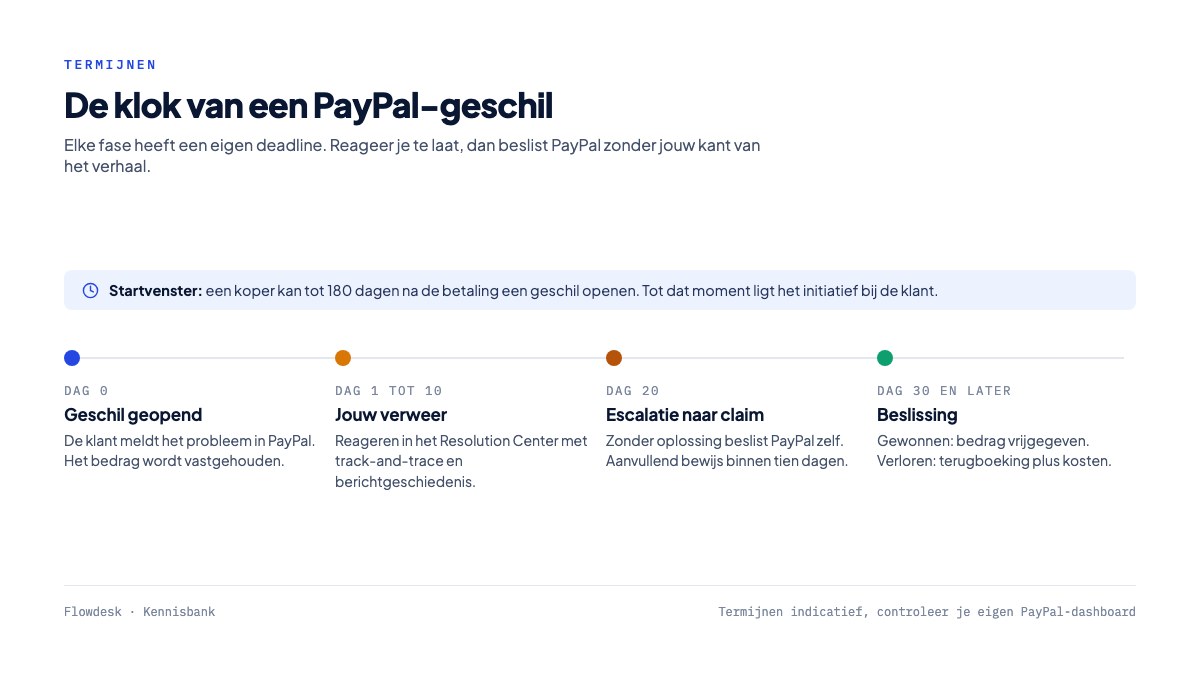
The two case types and their evidence
Almost every PayPal case falls into one of two categories, and they call for completely different evidence.
1. Item not received
The customer says the parcel never arrived. Here you win on proof of shipment. Make sure you supply:
- An online trackable tracking number showing the status delivered.
- The delivery address exactly as it appears in the PayPal transaction, not an address the customer emailed you later.
- The dispatch date, falling within the delivery time you promised.
- For orders above a certain amount: proof of signature on delivery.
2. Item significantly not as described
The customer says they got something other than what they ordered. This type is harder because it comes down to interpretation. Your response consists of:
- Screenshots of the product page as it was on the day of the order, showing sizes, material and colour.
- Photos of the product you actually shipped.
- The complete message history showing that you offered a solution.
- Your returns policy as the customer accepted it at checkout.
If the customer wins that kind of case, they normally have to return the product before they get their money. Ask for that explicitly in your response.
The playbook in six steps
- Respond within 24 hours, even when you do not know anything yet. A reply keeps the conversation in the dispute phase, where you still have influence.
- Identify the case type. Not received or not as described? That decides which evidence you gather.
- Assemble the complete file before you upload anything: proof of shipment, the address from the transaction, the product page, the messages and the terms.
- Write a factual response of five to ten lines: what was ordered, when it shipped, when it was delivered, which evidence is attached. No emotion, no blame.
- Upload everything in one go in the Resolution Center. Evidence you send afterwards is not always taken into account.
- Put the deadline in your calendar and check the day before whether PayPal is asking for anything extra.
The five most expensive mistakes
- Letting the deadline pass. By far the most expensive, and entirely avoidable.
- Shipping to a different address than the one in the transaction. That voids your protection.
- Shipping without an online trackable code. Without proof of delivery you have no case at all on item-not-received.
- Arguing instead of documenting. PayPal does not read who is right, PayPal reads evidence.
- Refunding immediately when in doubt. Understandable, but with a solid case you are giving away money you could have kept.
PayPal seller protection: when does it apply?
PayPal offers seller protection, but on strict conditions. In essence you must be able to show that you shipped the item ordered, on time, to the address in the transaction, with trackable proof. Digital products and services are generally excluded, and the protection lapses with a different address or missing tracking.
So treat it not as a safety net but as a checklist: as long as you meet those conditions you are strong in almost any case. If it keeps going wrong for you, read what a dispute really costs in our article on preventing chargebacks.
Not through better arguments, but by filing every case complete and within the deadline, following that provider's own procedure.
Frequently asked questions
How long do I have to respond to a PayPal dispute?
What happens if I do not respond to a PayPal claim?
What is the difference between a PayPal dispute and a claim?
What evidence do I need to win a PayPal dispute?
How long does a PayPal claim take?
What does a PayPal dispute cost?
When does PayPal seller protection apply?
Does the customer keep the product if they win?
What if the customer wants delivery to a different address?
How many disputes are normal for an online store?
Can I appeal a lost PayPal claim?
Does fast customer service prevent PayPal disputes?
Wessel builds the systems, automations and processes behind Flowdesk and writes in the knowledge base about disputes, chargebacks and customer service for online stores. His articles are based on the hundreds of disputes the Flowdesk team handles every month for online stores and dropshippers. Questions about this article: info@flowdeskagency.com.
Let specialists handle your disputes
Flowdesk files every case complete and inside the deadline at PayPal, Klarna, Stripe and Mollie. From EUR 0.70 per ticket, dispute management included.