Contents show
What exactly is a chargeback?
A chargeback is a payment reversal your customer requests not from you, but from their bank or payment provider. The customer tells them the payment was not right and asks for their money back. Depending on the payment method, that party is their bank, their card issuer or a provider such as PayPal or Klarna. The amount is then pulled out of your account before you get any say in it. Only afterwards do you get to prove the payment was legitimate.
That is the essential difference with an ordinary refund: with a refund you stay in control, with a chargeback the burden of proof is on you and the money has already gone. For online stores and dropshippers this is one of the most expensive and most underestimated costs there is.
Chargeback, refund and dispute: the difference
The terms get used interchangeably, but the distinction decides who is in control and what it costs you.
| Term | Who decides | What it costs you |
|---|---|---|
| Refund | You, voluntarily | The order value, nothing more |
| Dispute | The payment provider, after both sides respond | Nothing if you win, the order value if you lose |
| Chargeback | The bank or the card network | Order value plus a chargeback fee, and your ratio goes up |
What does a chargeback really cost your store?
The damage is always bigger than the order value. Count everything that actually disappears:
- The order value, reversed immediately.
- The chargeback fee from your payment provider, typically between EUR 15 and EUR 40 per case, even when you win.
- The product, usually already shipped or delivered, and rarely returned.
- The handling time: gathering evidence, filling in forms, tracking deadlines.
- Your chargeback ratio, the silent killer: card networks step in at around 0.9 to 1 percent of your transactions. Above that come fines, higher rates and eventually the loss of your payment methods.
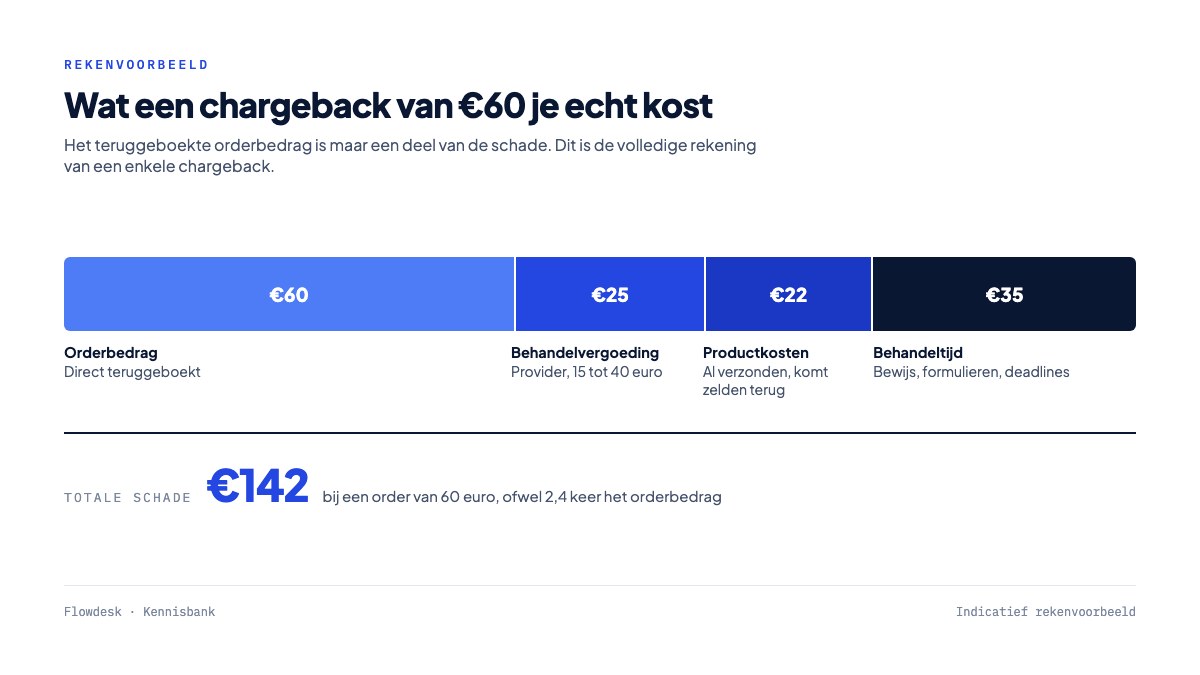
At ten chargebacks a month that is thousands of euros a year, before you even count the ratio risk.
The 5 most common causes
- No reply to their email. The customer emailed you first, heard nothing for days and then went to their bank or payment provider. By far the most avoidable cause.
- Delivery took longer than expected. Especially in dropshipping: the customer has no idea where the parcel is and concludes they have been scammed. More on this in our article on dropshipping customer service.
- An unrecognisable charge. The bank statement shows a different name than your store, and the customer simply does not recognise the payment.
- The product was not what they expected. The photo promised more than the box contained, or the size and colour were off.
- Friendly fraud. The customer received everything but files a claim anyway. Annoying, but this is exactly the category you can win with watertight evidence.
Seven ways to prevent chargebacks
- Answer every customer email within 24 hours. Almost every chargeback starts life as an unanswered email. Reply quickly and you catch the dispute before the bank ever gets involved.
- Be honest about delivery times, on the product page, in the checkout and in the confirmation email. Underpromise and overdeliver.
- Ship everything with tracking and share the link proactively. It removes the uncertainty and later becomes your single most important piece of evidence.
- Make sure your billing descriptor matches your store name, which you set at your payment provider. This one field wipes out the entire unrecognised-charge category.
- Send a dispatch and delivery confirmation. Every proactive email is one customer question fewer and one piece of evidence more.
- Make returning easier than claiming. A clear returns page with a simple process sends hesitant customers to the cheap channel instead of to their bank.
- Monitor your disputes in one place. You will miss ten-day deadlines if PayPal, Klarna and Stripe each live in their own dashboard. Track them centrally, or have someone do it for you.
Got a dispute anyway? How to win it
Even with perfect prevention you will still get disputes. Then only one thing counts: responding fast and in full, following that specific provider's procedure. Each of them has its own deadlines and its own evidence requirements:
| Payment method | Deadlines (indicative) | What makes the difference |
|---|---|---|
| PayPal | Buyers can open a dispute up to 180 days after payment; you usually respond within 10 days | Tracking and the complete message history. See the PayPal dispute playbook |
| Credit card (Visa, Mastercard) | A chargeback is usually possible up to 120 days after the transaction | Proof of delivery and a recognisable billing descriptor |
| Klarna | The payment is paused while the dispute runs | Respond quickly; if you do not respond at all, you lose automatically |
| iDEAL | No chargeback right: an iDEAL payment is final | Disputes here run through your own support, not through the bank |
The winning response is always the same recipe: the right evidence, in the right format, within the deadline. Tracking, the accepted terms, the product page as the customer saw it and the complete email exchange. Do that consistently and you win most cases; we win an average of 88 percent of them for our clients.
Frequently asked questions
What is a chargeback?
What does chargeback mean?
How long does a customer have to file a chargeback?
What does a chargeback cost an online store?
Can I fight a chargeback?
What is the difference between a chargeback and a refund?
How long does a chargeback take?
What is friendly fraud?
At what chargeback ratio do I get into trouble?
How do I calculate my chargeback ratio?
Do I get my product back after a chargeback?
Can a customer reverse an iDEAL payment?
Wessel builds the systems, automations and processes behind Flowdesk and writes in the knowledge base about disputes, chargebacks and customer service for online stores. His articles are based on the hundreds of disputes the Flowdesk team handles every month for online stores and dropshippers. Questions about this article: info@flowdeskagency.com.
Rather never file a dispute yourself again?
Flowdesk takes your tickets, returns and disputes off your hands entirely, from EUR 0.70 per ticket. We win 88 percent of all cases for our clients.